55 kHz or 45 kHz? Cracking Cleveland's Trickiest Bat ID Puzzle

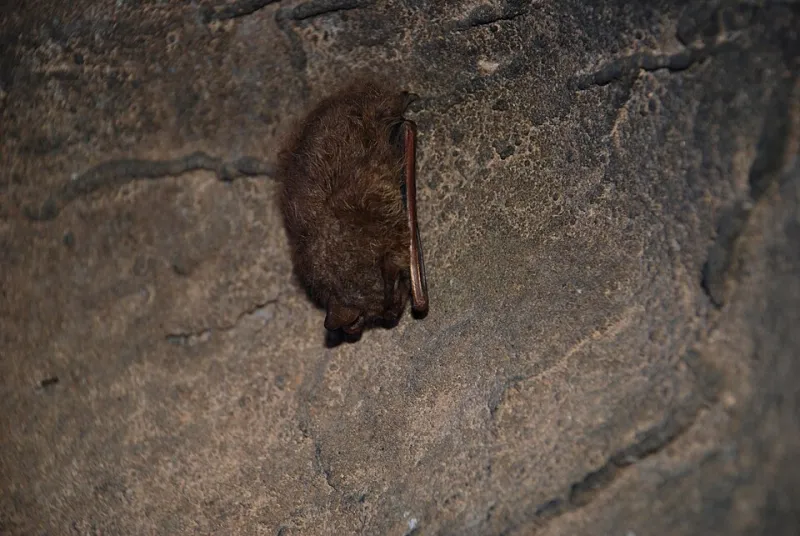
Photo: Drahkrub Attribution must include the URL http://de.wikipedia.org/wiki/Benutzer:Drahkrub, CC BY-SA 4.0, via Wikimedia Commons
You've done everything right. The dusk walk went ahead, the detector behaved, and you've got a clean sequence of calls from a pipistrelle hawking along the Tees. There's just one problem: the frequency of peak intensity is sitting stubbornly at 50 kHz, right between the two species it could be.
Welcome to the most common identification headache in Cleveland bat recording. The good news? With a bit of practice, most records can be resolved. And the even better news — knowing when to leave a record as 'Pipistrellus sp.' is a mark of a good recorder, not a lazy one.
Start With the Numbers
The headline difference is echolocation. Common pipistrelles (Pipistrellus pygmaeus — no wait, we mean P. pipistrellus for common!) call at around 45 kHz, while sopranos (P. pygmaeus) centre on 55 kHz. If your peak frequency lands clearly at 44–47 kHz, you can usually call it a common with confidence. Anything at 53–57 kHz points to soprano.
But bats don't read the textbooks. Individual variation, temperature, humidity and even the bat's behaviour can shift things. A bat feeding furiously over a Guisborough pond may push its calls higher than the same species commuting along a hedgerow. That's why one number is never enough — look at the whole call, and ideally several calls in sequence.
Flight Style: A Subtle Clue
If you're watching rather than just listening, there are differences worth noting. Common pipistrelles tend to be the slightly bulkier of the pair, with a fast, jerky, twisting flight. Sopranos are marginally smaller and often fly a little more weakly — though in the field, at dusk, over a Marton burn, you'd struggle to swear to it on wing shape alone.
Treat flight as supporting evidence, never the verdict. It's the sort of thing that's useful when combined with a detector reading, and useless on its own.
What the Roost Tells You
Roost features can be surprisingly helpful. Sopranos show a strong preference for water-adjacent roosts — bridges, culverts, crevices near ponds and rivers — which fits with their fondness for hunting aquatic insects. Commons are the classic 'house bat', favouring crevices behind fascias, soffits and lifted roof tiles.
If you've recorded a pipistrelle emerging from under a bridge over Skelton Beck, the odds tilt soprano-wards. A colony squeezing behind the barge boards of a 1930s semi in Redcar? Probably common. Probably.
Timing and Habitat Patterns
Across Teesside, sopranos dominate around water bodies and wetland edges — think the Tees barrage, Coatham Marsh, the old brick ponds. Commons are more of a generalist, happy in gardens, parkland and farmland hedges. Neither rule is absolute, but habitat context is another useful data point to weigh alongside your peak frequency.
Season matters too. Both species are strongly crepuscular, but roost emergence counts are easiest in early summer, when females are pregnant and lactating and leave foraging windows are predictable.
When to Write 'Pipistrellus sp.'
Here's the bit that separates careful recorders from wishful thinkers. If your peak frequency sits at 48–52 kHz, if the recording is clipped or noisy, or if the bat was passing rather than foraging (passing calls are often less typical), then the honest answer is: you don't know.
And that's fine. A record of 'Pipistrellus sp.' still tells our county recorder something valuable — that pipistrelles are using that stretch of the Leven, that a roost is likely nearby, that the site matters. What it doesn't do is inflate the soprano count with wishful thinking. Over-recording rare-ish species is a real problem for local datasets, and Cleveland's records are only as good as our discipline.
A Practical Checklist
Before you submit, run through these:
- Peak frequency — clearly at 45 or 55 kHz? Good sign.
- Call shape — typical pipistrelle structure, or something odd that suggests myotid confusion?
- Multiple calls — did several calls agree, or is one outlier carrying the ID?
- Habitat and roost context — water or buildings? Does it support the sonic evidence?
- Recording quality — would you defend this ID if challenged?
If three or more of those point the same way, record the species. If not, 'Pipistrellus sp.' is your friend.
Get Better With Practice
The fastest way to sharpen your ear and eye is to record at sites where both species occur together and compare directly. Bring your recordings along to one of our winter indoor sessions — there's nothing like arguing over a spectrogram with a cup of tea to make the distinctions stick.
Because in the end, good identification isn't about always being certain. It's about knowing exactly how certain you are — and recording that honestly.